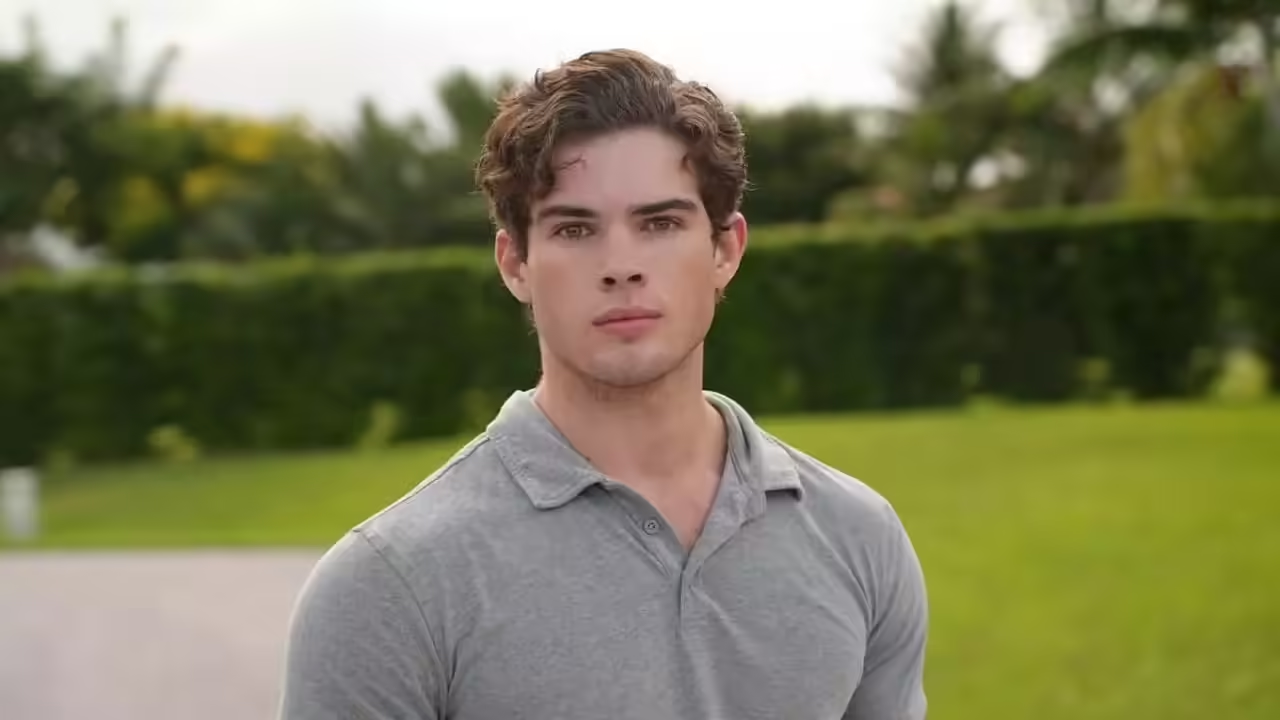

On February 12, 2026, during New York Fashion Week, 20-year-old looksmaxxing streamer Clavicular walked a runway for designer Elena Velez. The show featured a collaboration with the net-art collective Remilia Corporation, blending avant-garde aesthetics with Yakuza-inspired tailoring. Just weeks earlier, the same internet personality had been at the center of multiple viral controversies.
That contrast—runway model one day, shock-content streamer the next—captures the speed of his rise. Born Braden Peters, the New Jersey prep-school student turned livestream provocateur has surged toward one million followers across platforms in under three months. The obvious question: can anyone sustain attention at this velocity?
The Numbers Behind the Explosion
In early December 2025, Clavicular had roughly 170,000 TikTok followers. By late January 2026, he had more than quadrupled that number. Add a large Kick audience, and his total reach approaches 900,000.
The pace rivals—or exceeds—the early trajectory of figures like Andrew Tate, whose 2022 rise to global notoriety unfolded over several months. Clavicular’s surge compressed that timeline dramatically. But virality research suggests a brutal tradeoff: the faster the ascent, the shorter the lifespan. Trends that ignite overnight often collapse just as quickly.
The Confession That Explains Everything
During a livestream with Sneako, Clavicular reacted to the possibility that his girlfriend might be pregnant by framing it as potential “content.” The moment landed with unusual clarity: he wasn’t joking.
That mindset—life as raw material for engagement—is central to understanding him. He doesn’t merely chase algorithms. He organizes reality around them.
The Forge: Looksmaxxing Ideology
Clavicular emerged from the online looksmaxxing subculture, a movement rooted in incel forums that treats attractiveness as a measurable system of facial ratios and skeletal markers. Metrics like canthal tilt and jawline projection become optimization targets.
He embraced this framework early, experimenting with hormones as a teenager and eventually being expelled from college after hiding testosterone in his dorm. Even his alias reflects the ideology: “clavicular” references collarbone width, considered a symbol of masculine dominance in those communities.
Controversy as Fuel
His shift from niche influencer to national attention happened through escalating incidents:
-
A viral clip allegedly showing him injecting his underage girlfriend with cosmetic peptides.
-
A Christmas Eve livestream involving a Tesla Cybertruck confrontation that appeared to injure a man.
-
Appearances with figures such as Nick Fuentes and the Tate brothers, including singing along to an antisemitic track associated with Kanye West.
-
An interview with commentator Michael Knowles, where he insulted U.S. Vice President JD Vance while praising California governor Gavin Newsom in looks-based terms.
He even declined an invitation connected to billionaire Peter Thiel, turning the rejection itself into viral content.
Each controversy didn’t damage his brand—it expanded it.
Contentmaxxing: When Metrics Replace Meaning
Writer Aidan Walker describes a worldview where measurement becomes the only meaningful lens. In that framework, outrage isn’t moral—it’s numerical. Keywords drive engagement. Shock drives reach.
Clavicular embodies that logic. He isn’t gaming the system; he is the system.
The Irony
Commentators like Thomas Chatterton Williams have compared him to Dorian Gray, the beauty-obsessed protagonist created by Oscar Wilde. The twist: instead of a hidden portrait decaying in private, the deterioration unfolds publicly through livestreams and headlines.
Despite extreme body modification and steroid use, observers note he likely would have had ordinary social success without any of it—making the obsession itself the tragedy.
Will He Last?
Several forces threaten his longevity:
-
Platform bans or legal trouble
-
Escalation fatigue (shock content requires constant escalation)
-
Audience burnout once novelty fades
But there are counterweights:
-
Connections within influencer ecosystems
-
A young Gen-Alpha audience forming early loyalties
-
Controversy that continually renews attention
A reasonable estimate: roughly a one-third chance he remains highly relevant six months from now. More likely, he burns out quickly but resurfaces periodically—an internet figure who never fully disappears.
A Historical Parallel
The closest comparison may not be modern influencers at all, but 19th-century showman P.T. Barnum, who understood that spectacle itself was the product. As journalist Elizabeth Kolbert wrote in The New Yorker, audiences often want to be entertained more than informed.
Clavicular operates in that same tradition—except the algorithm replaces the circus tent.
The Blueprint, Not the Exception
It’s tempting to treat him as an anomaly. But he may represent something more unsettling: the logical endpoint of the attention economy. Strip away relationships, stability, and meaning, and optimize only for engagement, and you arrive somewhere very close to where he is now.
His story draws on reporting and commentary from outlets including The Atlantic, Wired, Rolling Stone, UnHerd, Spiked, and The Bulwark.
Because in a world ruled by metrics, the most optimized person wins—at least until the algorithm moves on.
And Clavicular? By his own admission, he’s only thinking about content.